






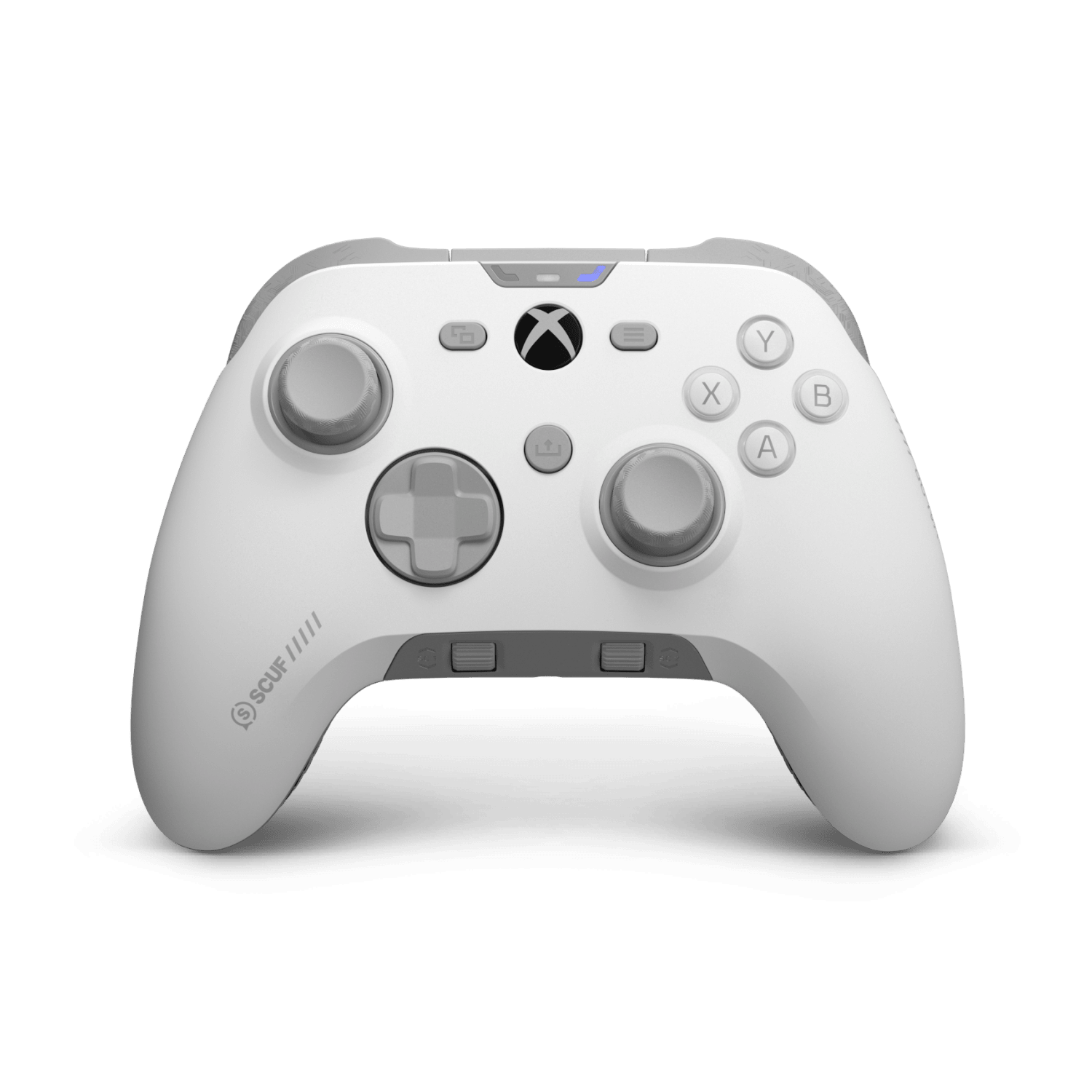


A standard PC controller does the job. The question is whether a custom or performance-built controller does it well enough to justify the price difference. For most serious PC players, the answer comes down to three things: what you play, how much you play, and what a controller that lasts actually costs over time.

What you actually get for the price difference
The gap between a standard controller and a custom or performance PC controller isn't cosmetic. The price buys you hardware changes that affect how the controller performs and how long it lasts. The specific differences worth paying for:
More inputs. A standard controller gives you the same layout that's been standard for thirty years. A custom performance controller like the SCUF Envision adds 11 additional remappable inputs, including rear paddles, G-Keys, and side buttons. For PC gaming in particular, where keyboard and mouse players have access to dozens of mapped keys, a controller that closes that input gap is a genuine competitive tool rather than a lifestyle accessory.
Better components. Mechanical buttons register faster and more consistently than membrane. Hall Effect thumbsticks eliminate the wear-based drift that makes standard controllers unreliable over time. Braided cables and tighter build tolerances extend the physical lifespan. These aren't abstract quality claims, they're component choices with measurable effects on performance and longevity.
Higher polling rate. Standard controllers typically operate at 125Hz, meaning inputs are reported every 8ms. The Envision operates at 500Hz (every 2ms). The Valor Pro Wired supports 1,000Hz on PC. That's the difference between a controller built around PC's technical requirements and one that happens to connect via USB.
Software integration. On PC, a controller that integrates with iCUE or a companion app gives you control over remapping, sensitivity, deadzone, and macro creation that a standard controller simply doesn't offer. That customisation layer compounds in value for players who maintain different profiles for different games.
The total cost of ownership argument
Standard controllers typically drift within 1.5 to 3.5 years under regular use, because their thumbsticks use physical contacts that wear down over time. That's not a worst case, it's the expected lifespan of the component. Replacing a standard controller every two years compounds into real cost over a PC gaming lifetime.
Hall Effect and TMR thumbsticks don't wear the same way. The sensing mechanism is magnetic, not physical, so the primary failure path is removed. A controller built with Hall Effect thumbsticks, quality switches, and durable materials is designed to outlast multiple generations of standard controllers. The higher upfront cost looks different when the denominator is five or more years of use rather than two.
Who benefits most from the upgrade
Competitive PC players — the polling rate, additional inputs, and software customisation provide direct performance advantages that compound over a competitive season. If you're playing ranked modes, esports titles, or any game where input speed and access matter, the upgrade is straightforward.
Frequent PC gamers across multiple genres — players who switch between shooters, RPGs, racing games, and platformers benefit from a controller that can be remapped per profile rather than forcing compromises across every genre. The G-Keys and macro capability on the Envision make this particularly useful.
Players who've experienced drift — if a previous controller has drifted, the hardware reason is clear and the Hall Effect solution is direct. Upgrading to a controller without that failure path addresses the root cause rather than delaying it.
Casual players who game infrequently — the performance case is weaker for players who pick up a controller a few hours a week for non-competitive play. The durability case still applies, but the urgency is lower. For this group, the upgrade is about longevity and build quality rather than competitive advantage.
The honest answer
Custom and performance PC controllers are worth buying over standard ones if you play regularly, care about how your inputs register, and want a controller that lasts. They're less obviously worth it if you play casually and rarely and aren't bothered by standard-controller limitations. The performance gap is real. Whether it's a priority depends on how you play.
The SCUF Envision is built specifically for PC gamers who want the full performance upgrade: mechanical buttons, Hall Effect thumbsticks, 500Hz polling, 11 additional inputs, and iCUE integration. See the full spec comparison in the SCUF Controller Comparison Guide.
For players who want the absolute ceiling on PC controller performance, the SCUF Nemesis Pro 8K is now available for pre-order — 8,000Hz polling, TMR thumbsticks, mechanical buttons, and four rear paddles in a PC-native build. Wired from $119.99, wireless from $199.99, shipping fall 2026.
SCUF's most advanced PC controller yet. Pre-order the Nemesis Pro 8K now for fall 2026 delivery.