


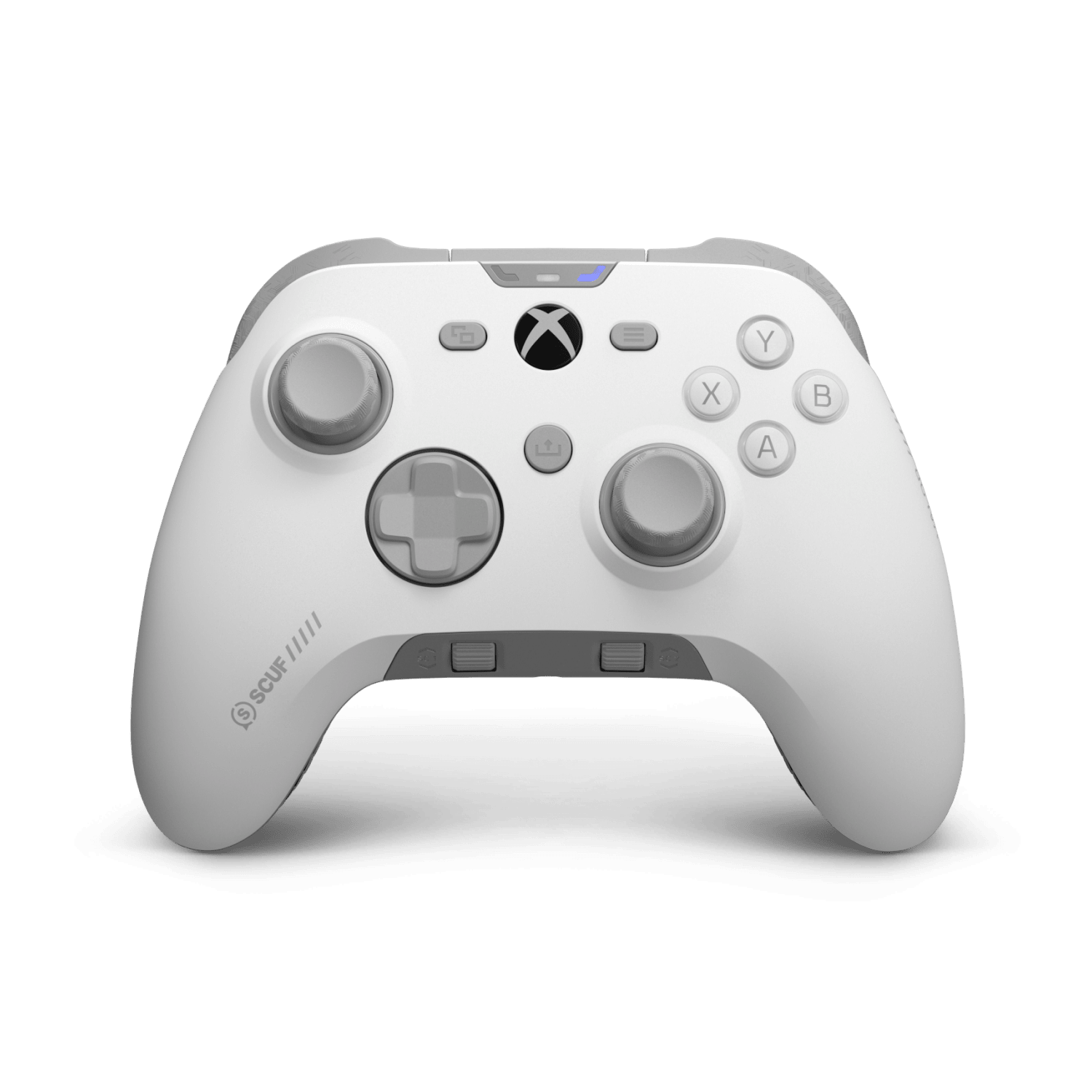
Press A on a standard controller. Feel that? The slight give, the soft collapse, the vague moment where you are fairly sure the input registered but could not tell you exactly when.
That is a rubber dome. It is the same basic mechanism that has sat under controller face buttons for decades, and for most of what people play, it is fine.
It is not fine when you are trying to hit a reload cancel on a specific frame.
SCUF Nemesis replaces the domes under A, B, X, and Y with mechanical switches. We call it Instant ABXY. Here is what actually changes, and why it was worth the engineering to get it into a controller at this price.
HOW A MEMBRANE BUTTON WORKS — AND WHERE IT LOSES YOU TIME
A membrane button is a small rubber dome sitting over two contacts on a circuit board. Press down, the dome deforms, collapses, and completes the circuit. Release, and the rubber's own elasticity springs it back.
Two problems come out of that design.
The travel is long and the actuation point is vague. The dome has to compress a meaningful distance before it collapses. Worse, that collapse is gradual rather than instantaneous — there is a soft, mushy zone where the button is partway down and you cannot tell by feel whether the contact has closed. Under pressure, players compensate by bottoming out every press to be certain, which adds travel distance and therefore time to every single input.
The rubber degrades. Every press stresses the dome. Over thousands of hours the elasticity fades, the tactile response softens, and the actuation force drifts. This is why a well-used controller feels different from a new one — the buttons are the same, but the rubber is not. Anyone who has replaced a controller because the face buttons "went mushy" has met this failure mode.
WHAT A MECHANICAL SWITCH DOES DIFFERENTLY
A mechanical switch does not rely on rubber deformation. It uses a metal contact mechanism with a defined actuation point — a specific position in the travel where the circuit closes, every time, identically.
Three things follow from that.
Shorter actuation distance. The switch registers earlier in the press. Less physical distance to travel means less time between the decision to press and the input landing. Multiply that across an entire match and the difference is not theoretical.
Audible and tactile click feedback. You get a distinct click — both felt through your thumb and heard — at the exact moment of actuation. This is the part players underestimate. You are not guessing whether the input registered; you know. That certainty means you stop bottoming out, and you start pressing only as far as the switch requires. Faster inputs, less finger fatigue over a long session.
Significantly longer lifespan. The mechanical switches on Nemesis are rated for 5 million actuations — far beyond what a rubber dome delivers — and, more importantly, they hold their feel across that entire lifespan. The actuation point does not migrate as the controller ages. Consistency is not a bonus feature for a competitive player. It is the whole point.
LIKE A GAMING MOUSE BUTTON
The most useful comparison is one you already have in your hand.
The switch under the left button of a high-end gaming mouse is a mechanical switch, and it is why a good mouse feels decisive — a crisp, immediate, unmistakable click with no soft zone. Nobody has shipped a serious competitive mouse with membrane buttons in a very long time. That argument was settled.
Instant ABXY brings that same feel to controller face buttons. If you are a PC player who moves between mouse and controller, it collapses a gap you have probably been unconsciously compensating for.
WHERE YOU'LL NOTICE IT
Rapid repeated inputs. Anything requiring a fast sequence of presses — animation cancels, weapon swap chains, movement tech that strings inputs together. A shorter actuation distance and a faster reset mean each press in the chain costs you less.
Precise, timing-critical single inputs. Parries, dodges, ability windows, jump timings. The moments where you need the input to land at a specific instant rather than approximately when you meant it. A defined actuation point removes the guesswork.
Long sessions. Because you are not bottoming out every press, your thumb travels less over thousands of inputs. That shows up as less fatigue in hour five.
Every button feeling the same. On a membrane controller, buttons wear unevenly — the one you use most degrades fastest. Mechanical switches age far more gracefully, so your most-used button does not drift away from the rest.
WHY WE PRIORITIZED IT FOR NEMESIS
This came out of SCUF Omega. We put the same mechanical switches on Omega, and the response from players made the direction obvious: once you have used mechanical face buttons on a controller, going back to membrane feels like a downgrade you did not agree to.
Nemesis is a controller built around removing latency wherever it exists. It would be strange to engineer an 8,000Hz polling rate, and then leave a soft, imprecise rubber dome sitting between your thumb and that pipeline. The fastest data path in the world does not help if the input has to wade through a mushy button first.
So the commitment is straightforward: SCUF controllers going forward carry the best and most current switch technology available. Instant ABXY on Nemesis is that commitment applied to a PC-first competitive controller.
INSTANT ABXY VS. ADJUSTABLE INSTANT TRIGGERS
These are two different features and they get conflated, so worth separating.
Instant ABXY is about the face buttons — mechanical switches replacing membrane domes.
Adjustable Instant Triggers are about the triggers, not the face buttons — flip a switch to choose between an instant, short-throw click for fast taps or a full trigger pull for analog control. Different mechanism, different job.
Both are on both Nemesis models. Together with the remappable back paddles, they cover the three input groups you lean on hardest in a competitive shooter.
Mechanical face buttons are louder than membrane. That is not a defect; it is the audible half of the tactile feedback. If you play late at night next to a sleeping housemate, or you run an open mic on stream, you will hear the click, and so might your chat.
Most players who make the switch decide the feedback is worth it — the same trade the entire mechanical keyboard category is built on. But it is a real difference, and you should know about it before you buy rather than after.
8K polling rate is the headline number on Nemesis. Instant ABXY is the feature you will notice within about ten seconds of picking it up.
Shorter travel. A defined actuation point you can feel and hear. A lifespan that holds its feel instead of slowly going soft. It is a small mechanical change that shows up in every single input you make, in every game you play.