






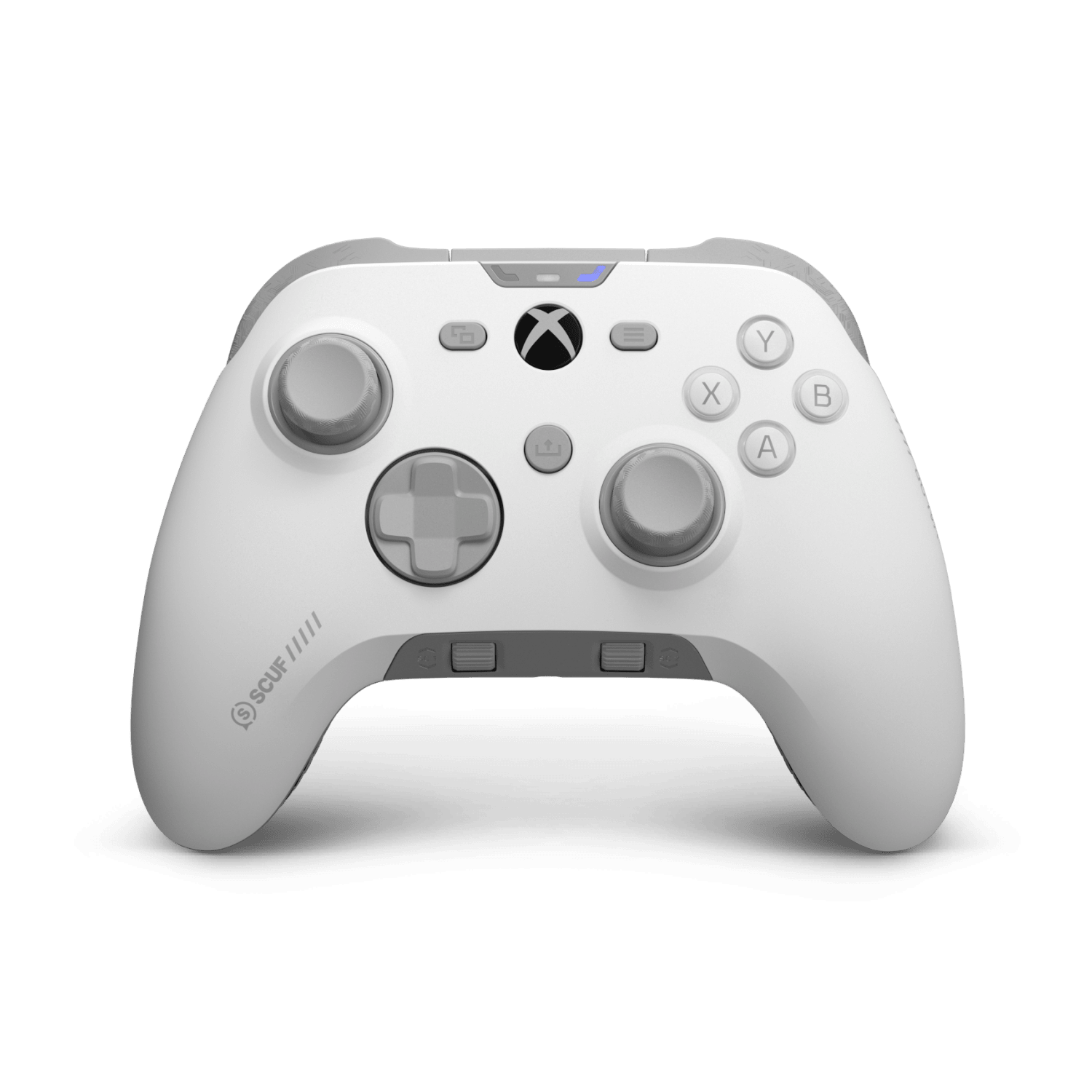


Keyboard and mouse is faster for some games. A controller is better for others. PC gaming's advantage is that you don't have to choose one permanently — and knowing which input method fits which game is the difference between playing properly and fighting your own controls.
The "KBM is always better" take is genre-specific, not universal. It's accurate for competitive FPS, where mouse precision for aiming and keyboard access for movement give an input ceiling controllers can't match. For most other genres, the comparison is more nuanced — and for many of them, a controller is the better tool.
The core advantage of a controller is analogue input. Thumbsticks provide graduated, directional movement that keyboard keys don't. Camera control, character movement, and vehicle handling all benefit from analogue input in ways that digital key presses can't replicate precisely. A keyboard can only tell you a key is pressed or not; a thumbstick tells you how far and in which direction.
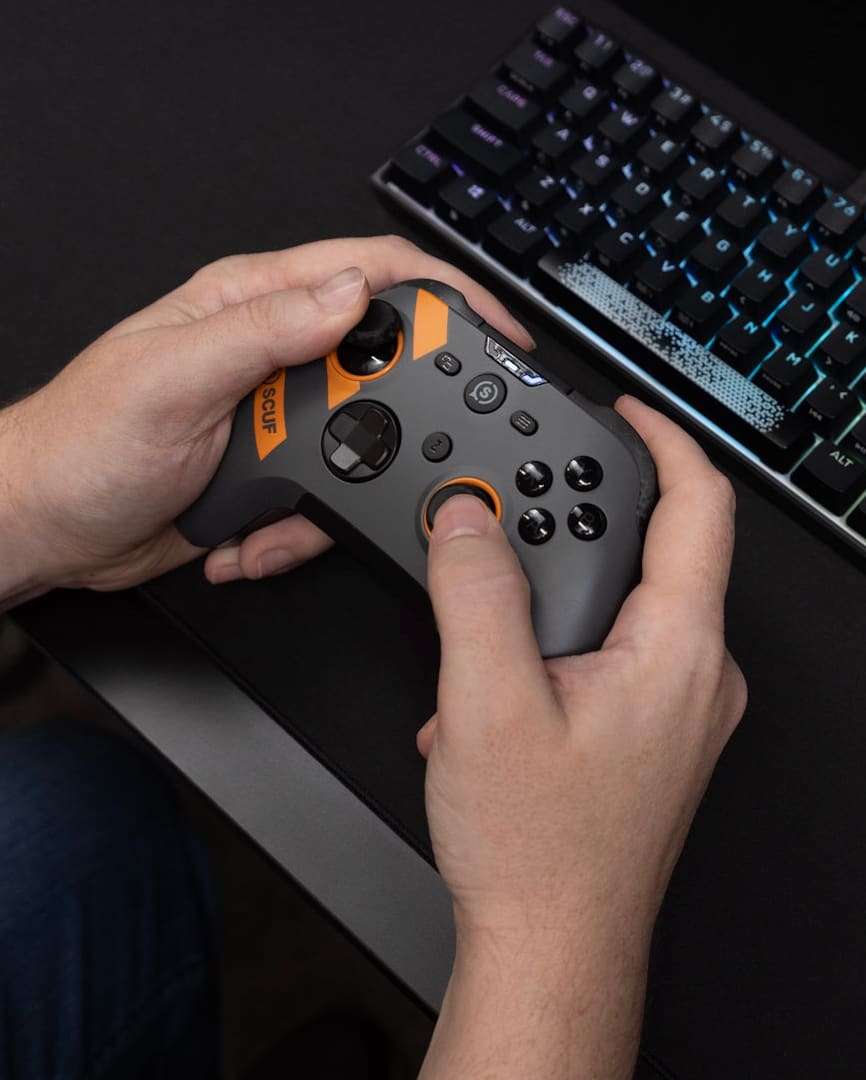
Genre-by-genre: where controllers win on PC
Action RPGs and soulslike games. Games like Elden Ring, Dark Souls, and Black Myth: Wukong are designed around controller input. Lock-on, dodging, attacking, and camera management are built around analogue thumbstick control and trigger inputs. Playing these on keyboard and mouse is technically possible but functionally awkward — the games' own developers typically recommend controllers for this reason. The SCUF Envision's rear paddles add a meaningful advantage here: dodge and sprint can be mapped to paddles, freeing face buttons for attacks and keeping thumbstick control continuous through evasion sequences.
Racing and driving simulators. Analogue trigger control for throttle and brake is the clearest case for controllers over keyboard in any genre. Keyboard keys are binary — fully pressed or not pressed. Triggers give you graduated input that allows real throttle control, trail braking, and proportional application of power that driving physics actually respond to. For sim racing on PC, a dedicated racing wheel is ideal, but a performance controller with adjustable triggers is a significant step above keyboard for anyone who doesn't own a wheel setup.
Platformers and action-adventure games. Precision platformers, from Celeste to Hollow Knight to the latest Mario-adjacent PC releases, are built around controller input. Jump arcs, wall-climb timing, and movement feel are tuned for analogue control. Keyboard players can complete these games but typically report worse feel on precision sequences.
Sports games. FIFA, NBA 2K, and similar titles are almost universally played with controllers on PC. The input language of these games — triggers for shooting pressure, thumbsticks for player movement and ball control — is built for controllers. Keyboard bindings are an afterthought in the design.
Third-person action and adventure. Games with camera control, melee combat, and exploration (God of War on PC, Spider-Man, Ghost of Tsushima) are designed around controller layout. Face buttons, triggers, and the left/right stick split between movement and camera are the intended input scheme.
Cloud gaming. Any game streamed via Xbox Game Pass, GeForce Now, or PlayStation Remote Play was designed for a controller. Playing console-native titles through a cloud service on PC with keyboard and mouse is fighting the game's design intent. A controller gives you the experience the game was built for.
It depends on the game, not the platform
The more accurate framing isn't "KBM vs controller" — it's "what did the developers design for." Games like Counter-Strike, Valorant, and Rainbow Six Siege are built from the ground up for keyboard and mouse, with no aim assist and a competitive ecosystem that's standardised on KBM. Mouse precision for fine pixel-level targeting has a genuine edge in these titles, and the pro scenes reflect that.
Call of Duty and Battlefield are a different story. These franchises are designed with aim assist as a core mechanic — not an accessibility feature, but a fundamental part of how the game plays. On console, controller aim assist is strong enough that top players have always preferred it over mouse. On PC with crossplay enabled, controller players with strong rotational aim assist regularly compete with and outperform KBM players in close-range engagements. SCUF has powered over 100 won titles in the CDL, where controllers aren't just accepted — they're the standard.
Strategy games, MOBAs, and RTS titles are built around click-based precision and keyboard shortcuts that controllers can't replicate efficiently regardless of aim assist — these are genuinely better on KBM. For players who switch between genres, PC-purpose controllers with G-Keys and macro capability, like the SCUF Nemesis Pro 8K, can map keyboard shortcuts to controller inputs to bridge that gap.
Getting the most from a controller on PC
Most modern PC games support controllers natively via Steam or direct input. Steam's controller configuration layer is the most powerful tool available — it lets you remap any controller input to any keyboard or mouse action, create per-game profiles, and apply sensitivity curves to analogue inputs. For SCUF controllers on PC, iCUE adds a further layer of configuration above Steam's options, including macro creation and hardware-mode profiles that persist without software running.
The combination of a performance controller and Steam's configuration layer means the "keyboard and mouse only" limitations of PC gaming are largely removed for the genres where controllers are the better tool. See the SCUF Controller Comparison Guide for the full PC lineup.
For players who want the absolute ceiling on PC controller performance, the SCUF Nemesis Pro 8K is now available for pre-order — 8,000Hz polling, TMR thumbsticks, mechanical buttons, and four rear paddles in a PC-native build. Wired from $119.99, wireless from $199.99, shipping fall 2026.
SCUF's most advanced PC controller yet. Pre-order the Nemesis Pro 8K now for fall 2026 delivery.